
New Hampshire Auto Insurance: Required and Voluntary Coverage
New Hampshire does not mandate liability insurance, but financial responsibility rules still apply. Call (833)-214-7506 to compare voluntary coverage options.

By Emma Bennett
New Hampshire stands alone among the fifty states: it is the only one that does not require drivers to carry auto liability insurance. That single fact creates more confusion, and more risk, than almost any other insurance rule in the country. Drivers who move to the Granite State from neighboring Massachusetts or Vermont often assume their old minimums still apply. Longtime residents sometimes assume they need nothing at all. Both assumptions can lead to expensive surprises after a crash. Understanding New Hampshire auto insurance requirements and voluntary coverage is not about satisfying a state inspector; it is about protecting your savings, your vehicle, and the people who share the road with you.
This guide explains what the state actually requires, what happens after an at-fault accident, which optional coverages are worth serious consideration, and how to compare quotes when there is no mandated minimum to anchor your shopping. The goal is practical clarity, not scare tactics. New Hampshire gives drivers more freedom than any other state, and with that freedom comes a decision that deserves real thought.
Why New Hampshire Does Not Require Liability Insurance
New Hampshire has never adopted a compulsory liability insurance law. The state instead relies on a financial responsibility system. The theory is simple: drivers are trusted to manage their own risk, but if they cause harm and cannot pay, the state can step in and require proof of future responsibility. This philosophy is rooted in the state's broader tradition of limited mandates, and it has survived repeated legislative attempts to change it.
For drivers, the practical effect is that you can legally register and operate a vehicle in New Hampshire without purchasing a single dollar of liability coverage. If a police officer pulls you over, you will not be asked for an insurance card in the way you would be in most other states. That does not mean you have no obligations, however. It means your obligations are triggered by events (a crash, a citation, a judgment) rather than by the act of registering a car.
Many residents do carry insurance anyway. Lenders and leasing companies require collision and comprehensive coverage on financed or leased vehicles, and most drivers recognize that going bare puts their personal assets on the line. According to national insurance data, the vast majority of New Hampshire drivers voluntarily purchase at least liability coverage, even though the state does not compel them to do so. The freedom exists, but most people choose not to use it.
The Financial Responsibility Rules That Still Apply
New Hampshire's financial responsibility law is where the state's requirements actually live. If you are involved in an accident, and especially if you are at fault, you can be required to demonstrate that you can pay for the damage you caused. The state sets specific minimum amounts for this purpose, and they apply to judgments, settlements, and certain license-related situations.
The core financial responsibility minimums in New Hampshire are as follows:
- $25,000 for bodily injury or death to one person in a single accident
- $50,000 for bodily injury or death to two or more people in a single accident
- $25,000 for property damage in a single accident
These figures represent the minimum you must be able to cover if the state requires proof of financial responsibility. You can satisfy that proof in more than one way. You can purchase a liability policy that meets or exceeds these limits. You can post a bond or cash deposit with the state. Some drivers use a certificate of self-insurance if they can demonstrate sufficient assets. For most people, a standard liability policy is the simplest route.
The trigger matters. If you are cited for certain violations, involved in an accident where damages exceed a threshold, or have a judgment entered against you, the state can request proof. If you cannot provide it, your license and registration can be suspended until you do. That is the real teeth behind New Hampshire's system: not a checkpoint at registration, but a consequence after something goes wrong. Drivers who skip insurance entirely are essentially betting that nothing will go wrong, and that bet can cost far more than a policy ever would.
What Happens After an At-Fault Crash
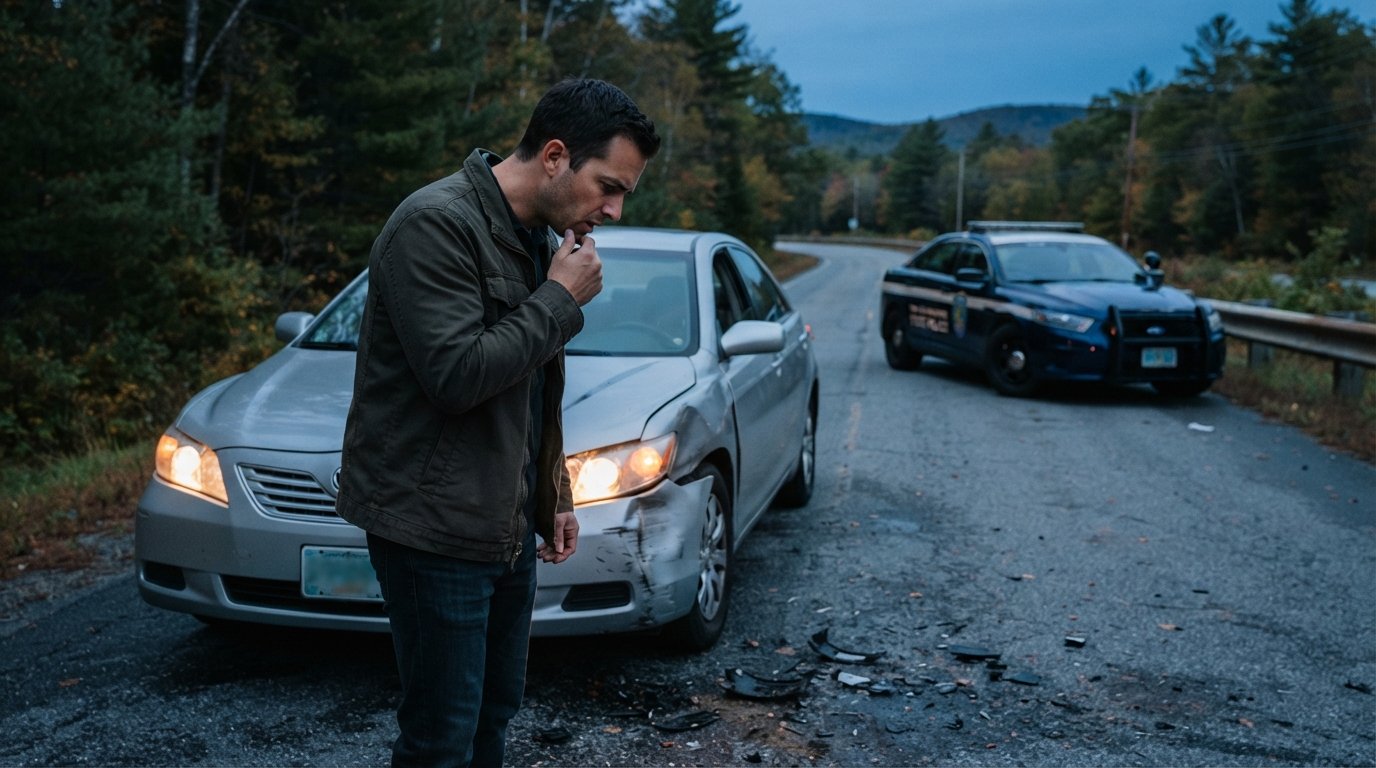
Imagine a typical scenario. A New Hampshire driver runs a red light and strikes another vehicle. The other driver suffers a broken wrist and the car needs $9,000 in repairs. If the at-fault driver has no insurance, the injured party can pursue a claim directly against that driver. A lawsuit may follow, and a judgment can be entered. At that point, the state's financial responsibility rules activate: the at-fault driver may need to prove the ability to pay the judgment or face suspension of driving privileges.
Even without a lawsuit, the at-fault driver's own insurer (if there is one) will handle the claim up to policy limits. If the damages exceed those limits, the driver is personally exposed. This is why choosing limits equal to the state minimums is often a false economy. The minimums are designed to satisfy the state, not to protect a household's savings. A serious injury can easily exceed $50,000 in medical costs alone, and property damage from a newer vehicle can blow past $25,000 quickly.
There is also the uninsured motorist problem. Because New Hampshire does not require liability insurance, you are more likely to encounter a driver who has none. If that driver hits you, your own uninsured motorist coverage becomes the safety net. Without it, your only path to recovery may be a personal lawsuit against someone who may have no assets. That is a difficult and slow route, and it is the strongest argument for carrying uninsured motorist protection even in a state that does not mandate it.
Voluntary Coverage New Hampshire Drivers Should Consider
Since the state does not set a mandatory menu, New Hampshire drivers have the widest possible range of choices. The coverages below are optional in the legal sense, but each one addresses a real gap that the state's financial responsibility system does not fill for you.
Liability coverage. Even though it is not required to register a car, liability coverage is the foundation of any sensible plan. It pays for injuries and property damage you cause to others, and it satisfies the state's financial responsibility thresholds. Buying limits above the minimums is usually inexpensive relative to the protection gained.
Uninsured and underinsured motorist coverage. This pays for your injuries when the other driver has no insurance or not enough. Given New Hampshire's unusual legal environment, this coverage deserves priority attention. It can also cover hit-and-run accidents in many policies.
Collision coverage. This pays to repair or replace your own vehicle after a crash, regardless of fault. If you finance or lease a car, the lender will require it. If you own an older car outright, you can weigh the premium against the vehicle's value.
Comprehensive coverage. This handles damage that is not a collision: theft, fire, hail, flooding, vandalism, and animal strikes. New Hampshire's winters and rural roads make animal strikes and storm damage realistic concerns.
Medical payments and personal injury protection. These cover medical expenses for you and your passengers after an accident, regardless of who was at fault. They can fill the gap left by health insurance deductibles and copays.
There is also a practical bundling angle. Many New Hampshire drivers own homes or rent apartments, and combining auto coverage with a homeowners or renters policy often reduces the total premium while closing coverage gaps. If you are exploring that route, our guide on auto insurance for renters and homeowners walks through how bundling works and where the savings come from.
How to Compare New Hampshire Quotes Without Mandated Minimums
In states with compulsory insurance, shopping is somewhat standardized: every quote includes at least the state minimums, so you compare apples to apples on price and service. In New Hampshire, quotes can vary wildly because each insurer is pricing a different set of optional coverages. A quote with no liability coverage will look cheap and tell you almost nothing. The comparison only becomes meaningful when you define your own baseline first.
A practical process looks like this:
- Decide on your target liability limits before you request any quote. Many advisors suggest limits well above the state financial responsibility figures, such as $100,000 per person and $300,000 per accident, depending on your assets and income.
- Choose whether you need collision and comprehensive coverage based on your vehicle's value and whether it is financed or leased.
- Add uninsured and underinsured motorist coverage at a level that matches your liability limits.
- Request quotes from multiple licensed agents using the same coverage profile so the prices are comparable.
- Ask each agent about discounts, including multi-policy, safe driver, and paid-in-full discounts, and confirm how they apply.
That last step matters more than most drivers expect. Two quotes with identical coverage can differ by hundreds of dollars per year once discounts are applied correctly. Asking directly about every available discount is one of the simplest ways to lower a premium without reducing protection. Drivers who need financing for a vehicle purchase, or who have been turned down by traditional lenders, may also want to explore independent connection services such as AutoTitleLoan to understand their options before finalizing a purchase.
Common Misconceptions About New Hampshire Auto Insurance
Several myths circulate among New Hampshire drivers, and each one can lead to a costly decision. The first is that insurance is simply not needed because the state does not require it. As the financial responsibility rules show, the absence of a mandate is not the absence of consequences. The second is that the state minimums, when they do apply, are adequate protection. They are not designed to be; they are designed to satisfy a legal threshold.
A third misconception is that uninsured motorist coverage is redundant if you have health insurance. Health insurance covers medical bills, but it does not cover lost wages, pain and suffering, or the difference between what the other driver owes and what they can pay. Uninsured motorist coverage can address those gaps. A fourth myth is that shopping for insurance in New Hampshire is pointless because there is no standard policy. In reality, the freedom to customize means a careful shopper can often buy better coverage for the same money as a minimum-only policy in another state.
Finally, some drivers believe that carrying no insurance protects them from being sued. The opposite is true. A driver with no insurance and no assets may face a judgment that follows them for years, affects their ability to obtain credit, and can lead to license suspension. Insurance is not just a payment mechanism; it is a buffer between an accident and the rest of your financial life.
Frequently Asked Questions
Is car insurance mandatory in New Hampshire?
No. New Hampshire does not require drivers to carry liability insurance to register or operate a vehicle. However, the state's financial responsibility law can require proof of ability to pay after certain accidents, violations, or judgments. Most drivers choose to carry insurance voluntarily.
What are the minimum coverage amounts in New Hampshire?
For financial responsibility purposes, the state sets minimums of $25,000 per person and $50,000 per accident for bodily injury, plus $25,000 for property damage. These are not registration requirements, but they represent the threshold the state may ask you to prove after an at-fault incident.
Do I need uninsured motorist coverage in New Hampshire?
It is not legally required, but it is strongly advisable. Because other drivers are not required to carry liability insurance, the risk of encountering an uninsured driver is higher than in most states. Uninsured motorist coverage protects you when the at-fault driver cannot pay.
Can I be fined for driving without insurance in New Hampshire?
You will not be fined simply for lacking insurance at a traffic stop, because no proof is required at registration. However, if you are involved in an accident or certain violations and cannot demonstrate financial responsibility, you can face license and registration suspension until you comply.
New Hampshire's approach to auto insurance is unusual, but it is not complicated once the pieces are clear. The state does not mandate coverage, but it does hold drivers accountable after the fact. That makes voluntary coverage a personal decision with real financial stakes. Drivers who take the time to set their own limits, prioritize uninsured motorist protection, and compare quotes on equal terms end up with better protection and fewer surprises than those who simply assume the state's rules are the whole story. Comparing options through a service that connects you with licensed agents can make that process faster and more transparent, and it costs nothing to see what is available.