
New Mexico Car Insurance Minimums and Uninsured Driver Risk
New Mexico minimum limits leave gaps that uninsured drivers exploit. Compare coverage and protect your finances. Call (833)-214-7506 for guidance.

New Mexico drivers face a reality that many other states do not: a large share of vehicles on the road carry no insurance at all. That single fact changes how you should think about the state minimum coverage you are legally required to buy. The cheapest policy that satisfies the law may leave you paying thousands out of pocket after a crash with an uninsured driver. Understanding both the legal floor and the real-world risk is the difference between being technically compliant and being genuinely protected.
This guide walks through New Mexico's required liability limits, how financial responsibility rules work, why uninsured and underinsured motorist coverage deserves serious attention, and how to choose limits that make sense for your budget and your exposure. If you want to see how your current coverage stacks up, you can start by pulling free auto insurance quotes online from multiple carriers and comparing them side by side before you make any changes.
New Mexico Minimum Liability Limits: What the Law Requires
New Mexico is a financial responsibility state, which means drivers must be able to demonstrate the ability to pay for damages they cause in an accident. In practice, almost everyone satisfies this requirement by purchasing liability insurance. The state's minimum liability requirements are split into three parts: bodily injury per person, bodily injury per accident, and property damage per accident.
As of 2026, New Mexico requires liability limits of at least $25,000 per person for bodily injury, $50,000 per accident for bodily injury, and $10,000 per accident for property damage. These are commonly written as 25/50/10. The numbers look reasonable on paper, but they are among the lower minimums in the country, and they have not kept pace with the actual cost of medical care or vehicle repair.
Consider what $25,000 actually buys. A single emergency room visit, an ambulance ride, and a few days of follow-up care can exceed that figure quickly. If you injure two people in an accident, the $50,000 per-accident cap applies to both of them combined. And $10,000 in property damage will not cover replacing a newer vehicle, let alone repairing multiple cars in a multi-vehicle collision. The minimum limits exist to satisfy the law, not to provide meaningful financial protection.
New Mexico also requires drivers to carry proof of insurance in the vehicle and to provide it when requested by law enforcement or after an accident. Driving without insurance can lead to fines, license suspension, and vehicle registration suspension. Repeat offenses carry steeper penalties, and the state can require an SR-22 certificate of financial responsibility after certain violations.
Why Uninsured and Underinsured Motorist Coverage Matters in New Mexico
New Mexico has one of the highest uninsured driver rates in the United States. Estimates from insurance industry research consistently place the state's uninsured motorist rate well above the national average, with roughly one in five drivers lacking coverage at any given time. That statistic is not abstract. It means that every time you merge onto a highway or pull into an intersection, there is a meaningful chance the other driver has no liability insurance to pay for the damage they cause.
Uninsured motorist coverage (UM) and underinsured motorist coverage (UIM) are designed for exactly this scenario. UM pays for your injuries and, in some policies, your property damage when the at-fault driver has no insurance. UIM kicks in when the at-fault driver has insurance but not enough to cover your losses. Both coverages typically apply to you, your passengers, and in some cases members of your household, whether you are in your own vehicle, a rental car, or on foot.
Here is the important part: New Mexico insurers are required to offer UM and UIM coverage, but you must actively reject it in writing if you do not want it. Many drivers, focused on keeping premiums low, sign away this coverage without realizing what they are giving up. The savings are usually modest, often just a few dollars per month, while the protection can be worth tens or hundreds of thousands of dollars.
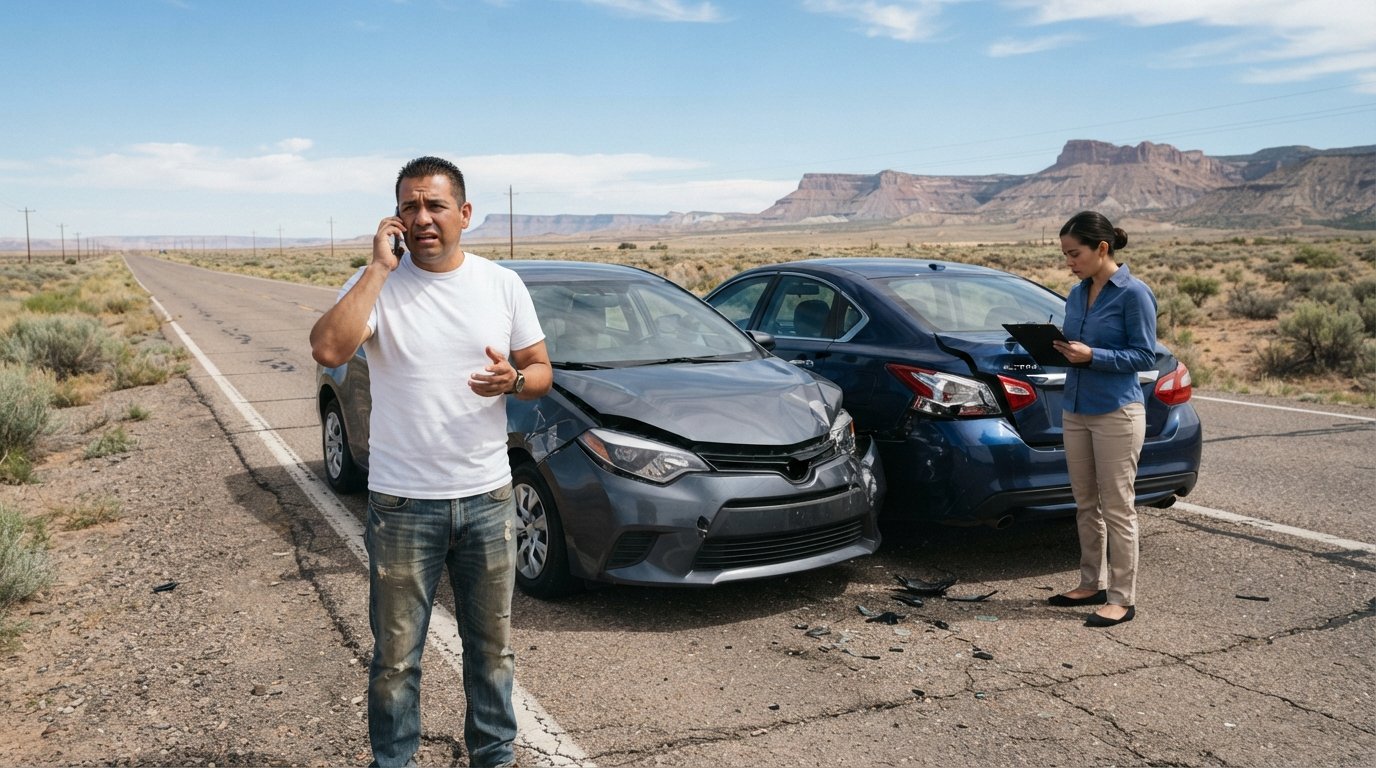
Picture a common New Mexico scenario. A driver runs a red light and strikes your vehicle, sending you to the hospital with a broken arm and a concussion. The other driver has no insurance. Your medical bills reach $40,000, and you miss several weeks of work. Without UM coverage, your health insurance may cover some of the medical costs, but it will not cover your lost wages, and it may pursue reimbursement from any settlement you receive. With UM coverage in place, you have a direct path to compensation for injuries the at-fault driver cannot pay for.
Property damage is a separate consideration. Some UM policies include property damage coverage, but many do not. If you want protection for your vehicle in an uninsured driver accident, you may need to rely on collision coverage or a UM policy that explicitly includes property damage. Reviewing the details of your policy matters here, because the difference between having UM and having UM with property damage can be significant after a crash.
How New Mexico Quotes Reflect Local Uninsured Driver Rates
Insurance premiums are built on risk, and uninsured drivers are a risk factor that carriers price into every policy they sell in New Mexico. When a large share of drivers on the road lack coverage, the cost of accidents involving uninsured motorists gets spread across the insured population. That is one reason New Mexico auto insurance rates tend to run higher than rates in states with lower uninsured rates.
If you have been shopping for coverage and noticed that quotes vary widely between carriers, part of that variation comes from how each company models local risk. Some insurers weight uninsured motorist exposure more heavily than others. Some offer more competitive rates for drivers with clean records or for households that bundle auto and home or renters coverage. This is why comparing quotes from multiple carriers is not just a money-saving tactic but a way to understand how different companies view your specific risk profile.
Geography matters too. Rates can differ noticeably between Albuquerque, Santa Fe, Las Cruces, and rural areas of the state. Urban areas with higher traffic density and higher accident frequency typically see higher premiums. The uninsured driver rate can also vary by region, and carriers adjust their pricing accordingly. When you request quotes, make sure you are comparing policies with identical coverage limits and deductibles, because a lower premium often reflects lower coverage rather than a better deal.
For drivers who want to see how minimum limits compare across states, our guide on how to compare minimum car insurance in Rhode Island offers a useful reference point for how different states structure their requirements and what that means for drivers who travel or relocate.
Choosing Limits That Balance State Minimums With Real-World Protection
The state minimum is a legal floor, not a recommended target. For most New Mexico drivers, carrying only 25/50/10 leaves a substantial gap between what the law requires and what a serious accident actually costs. The right limits depend on your assets, your income, your comfort with risk, and your budget, but a few general principles can help guide the decision.
First, think about what you could lose. If you cause an accident and the damages exceed your liability limits, you are personally responsible for the difference. That means your savings, your home equity, and potentially a portion of your future wages could be at risk. Liability coverage is not just about protecting the other driver; it is about protecting yourself from financial ruin.
Second, consider the cost of upgrading. Moving from minimum limits to more robust coverage often costs less than drivers expect, especially when bundled with other discounts. The difference between 25/50/10 and 100/300/100 might be $20 to $40 per month for many drivers, which is a small price for a much larger safety net.
A practical approach looks like this:
- Carry liability limits of at least 100/300/100 if your budget allows, which provides $100,000 per person, $300,000 per accident, and $100,000 for property damage.
- Add uninsured motorist coverage at the same limits as your liability coverage, so you are protected when the other driver has nothing.
- Include underinsured motorist coverage to fill the gap when the at-fault driver's policy is too small.
- Consider collision and comprehensive coverage if your vehicle is worth more than a few thousand dollars or if you could not easily replace it out of pocket.
- Review your policy annually, especially after a move, a vehicle purchase, or a change in household income.
Drivers with significant assets or high incomes may want to go further, with limits of 250/500/250 or a personal umbrella policy layered on top. Drivers with limited budgets can still improve their position by adding UM coverage even if they keep liability limits at a moderate level. The key is to make a deliberate choice rather than defaulting to the minimum because it is the easiest option.
What to Do If an Uninsured New Mexico Driver Hits You
Being hit by an uninsured driver is stressful, but a clear sequence of steps can protect your claim and your recovery. The actions you take in the first hours and days after the accident often determine how smoothly the process goes.
Start by making sure everyone is safe and calling 911 if there are injuries or significant damage. A police report is one of the most valuable pieces of evidence you can have, especially when the other driver lacks insurance. The responding officer will document the accident, gather statements, and record the other driver's information, including any citation for driving without insurance.
Exchange information with the other driver, but do not admit fault or speculate about who caused the crash. Take photos of the vehicles, the scene, and any visible injuries. Collect contact information from witnesses if anyone stops to help. Then notify your own insurer as soon as possible, even if you are not sure yet whether you will file a claim. Most policies require prompt notice, and delaying can complicate the process.
If you have uninsured motorist coverage, your claim will proceed through your own insurer under the UM portion of your policy. Your insurer will investigate the accident and, if the other driver is confirmed uninsured, handle the claim as if it were a liability claim against that driver. You may need to provide a police report, medical records, repair estimates, and documentation of lost wages. Keep thorough records throughout the process.
If you do not have UM coverage, your options are more limited. You may be able to pursue the at-fault driver personally, but collecting a judgment from someone without insurance is often difficult. Your health insurance may cover medical costs, and collision coverage may cover vehicle damage if you have it. In some cases, an attorney can help you evaluate whether pursuing the other driver is worthwhile, but the practical recovery is usually much smaller than what UM coverage would have provided.
The lessons are straightforward: carry UM and UIM coverage, document everything after a crash, and do not assume the other driver's insurance will be there when you need it. New Mexico's uninsured driver rate makes these steps more than just good practice. They are essential protection in a state where the risk is real and present on every drive.
If you are unsure whether your current policy includes adequate uninsured motorist protection, or if you want to compare limits and premiums from multiple carriers, connecting with licensed agents who can walk you through your options is a smart next step. The goal is not just to satisfy New Mexico's minimum requirements but to build coverage that holds up when the unexpected happens.