
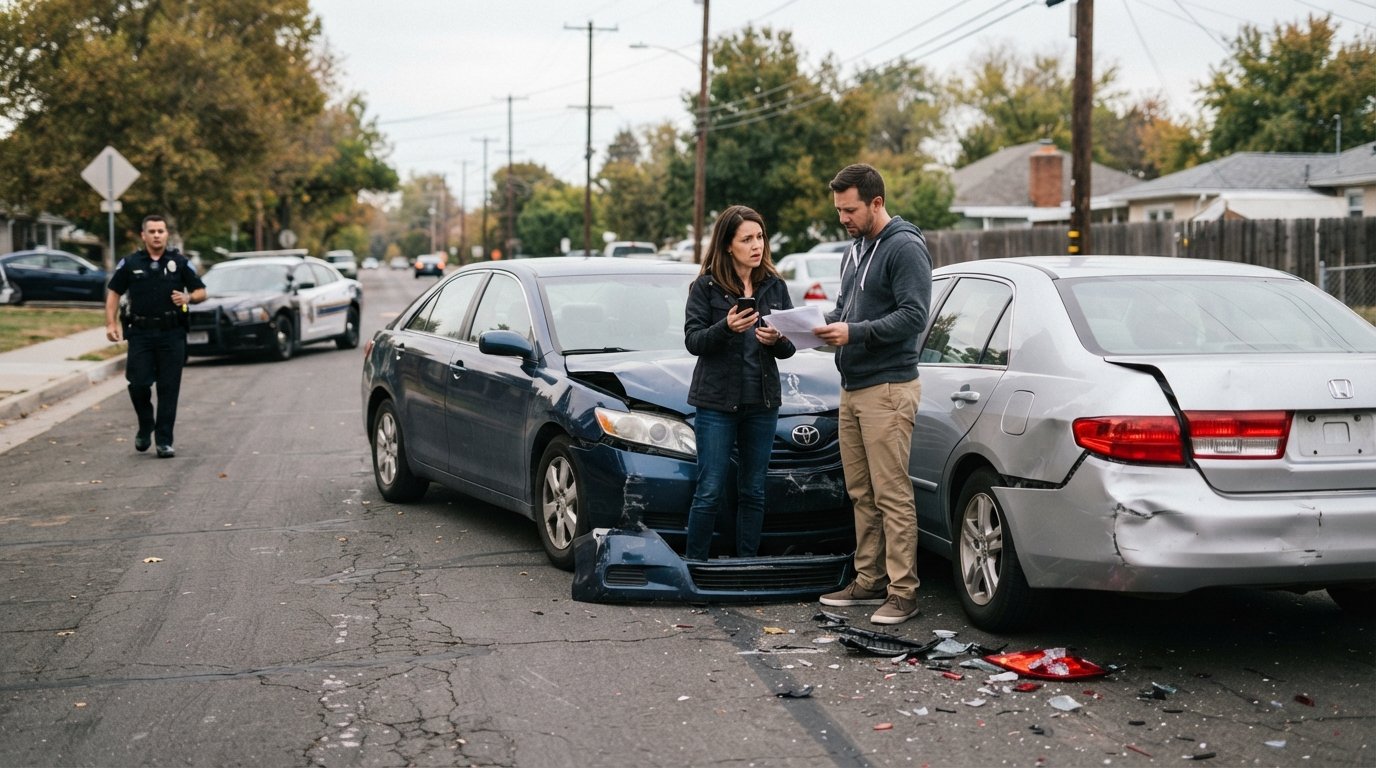
Driving Without Insurance and in an Accident: What Happens
Driving without insurance and getting in an accident triggers personal liability, license penalties, and higher future rates. Call (833)-214-7506 to compare coverage options.

By Callum Rivers
You hear the crash, feel the jolt, and exchange information with the other driver. Then the question hits you: your policy lapsed last month, and you have no idea what happens next. Driving without insurance and getting into an accident is not just a minor paperwork problem. It is a legal and financial event that can follow you for years, affecting your license, your bank account, and even your ability to buy affordable coverage later. The consequences vary by state, but the core reality is the same everywhere: when you are uninsured and at fault, you personally absorb costs that an insurer would normally handle. This guide walks through the real-world fallout, from immediate penalties to long-term insurance rate damage, and explains how to recover if you find yourself in this situation.
The Immediate Financial Liability of an At-Fault Uninsured Crash
In most states, the moment you are deemed at fault for an accident without insurance, you become personally responsible for the other party's damages. That means the other driver's vehicle repairs, their medical bills, lost wages, and even pain and suffering can be pursued against you directly. Unlike an insured driver whose liability coverage pays up to policy limits, you have no financial buffer. The other driver's insurer may pay their claim first, then subrogate against you to recover every dollar. That subrogation demand can arrive months later as a formal letter or a court summons.
Consider a typical scenario: you rear-end a newer sedan at a stoplight. The repair bill hits 9,000 dollars, and the other driver visits the emergency room with neck pain, adding another 12,000 dollars in medical costs. If you carry no liability coverage, you owe that 21,000 dollars out of pocket. Your savings, your tax refund, and potentially your wages through garnishment are all exposed. In states that allow wage garnishment for civil judgments, a portion of each paycheck can be taken until the debt is satisfied. Bankruptcy is sometimes the only escape, and that carries its own long-term damage.
Property damage is only part of the picture. If the crash injures someone seriously, medical costs can climb into six figures. An uninsured at-fault driver facing a catastrophic injury claim may see a judgment that exceeds anything they can realistically pay, leading to years of financial instability. This is why liability coverage exists: it transfers that risk to an insurer for a relatively modest premium. When you drive without it, you are self-insuring with assets you probably cannot afford to lose. The table below shows the kinds of costs that can land on your shoulders after an uninsured at-fault accident.
- Other driver's vehicle repair or replacement costs
- Medical bills for injuries to the other driver and passengers
- Lost wages if the other party cannot work during recovery
- Rental car costs while the other vehicle is in the shop
- Legal fees if you are sued and need representation
Those costs do not disappear because you cannot pay them. They follow you through collections, judgments, and credit reporting, which can affect your ability to rent an apartment, finance a car, or even get a job that runs a credit check. The financial hole dug by one uninsured accident can take a decade to climb out of, which is why reinstating coverage quickly matters so much.
License, Registration, and Legal Penalties for Driving Uninsured
Every state except New Hampshire requires some form of auto liability insurance, and the penalties for driving without it are separate from the accident itself. When law enforcement or the state DMV discovers you were uninsured, you face administrative consequences that stack on top of the civil liability. These penalties often hit before the other driver's claim even settles.
The most common immediate penalty is a license suspension. In many states, a first offense triggers a suspension ranging from 30 days to a full year, and reinstating the license requires proof of insurance plus a reinstatement fee. Some states also impound or tow the vehicle, adding storage fees to the bill. Registration suspension is common as well: your plates can be pulled, and you cannot legally drive the car until you show proof of coverage and pay the associated fees. These administrative actions happen regardless of fault, so even a not-at-fault crash can trigger penalties if the responding officer notes no insurance.
Beyond the DMV, criminal penalties may apply. A first offense for driving uninsured is often a misdemeanor with fines that range from a few hundred dollars to over a thousand, and repeat offenses can escalate to higher fines or even jail time in some jurisdictions. If the accident involves injuries, additional charges such as driving without financial responsibility may be filed. Courts can also order community service or mandatory insurance monitoring, where you must file proof of coverage (often an SR-22 form) for several years to keep your license valid.
Here is how the penalty sequence typically unfolds after an uninsured accident, though specifics vary by state:
- An officer or the other party reports the crash, and the state verifies your insurance status.
- The DMV issues a suspension notice for your license and registration, with a deadline to respond.
- You must pay reinstatement fees and provide proof of active coverage, sometimes including an SR-22 filing from your insurer.
- If you were at fault, the other party's insurer may pursue a civil judgment separately from the administrative penalties.
The SR-22 requirement deserves special attention. It is not insurance itself but a certificate your insurer files with the state confirming you carry coverage. Once flagged, you typically must maintain an SR-22 for three years, and your insurer must notify the state if your policy lapses again. Insurers view SR-22 filers as high risk, which directly affects what you pay for coverage going forward. Understanding these administrative layers helps you see why driving uninsured is a costly gamble even before the civil claim arrives.
How an Uninsured Accident Damages Future Insurance Eligibility and Rates
The accident does not end when the claim is resolved. Insurance companies share claims data through databases like CLUE and ISO, and an uninsured accident leaves a mark that follows you to every future application. When you apply for new coverage, most insurers ask whether you have had any accidents, and they verify the answer against those databases. A lapse in coverage combined with an at-fault accident is one of the strongest red flags in auto insurance underwriting.
The practical result is that you may struggle to find a standard carrier willing to insure you. Many mainstream insurers decline applicants with recent uninsured accidents or SR-22 requirements, pushing you into the non-standard market. Non-standard insurers specialize in high-risk drivers, and their premiums reflect that risk: you might pay two to three times what a clean driver pays for the same coverage. In some cases, the only option is a state-assigned risk pool, which offers basic liability coverage at elevated rates. The chart below summarizes how an uninsured accident can affect your insurance profile.
- Higher base premiums due to the at-fault accident and coverage lapse
- Limited carrier options, often restricted to non-standard insurers
- Mandatory SR-22 filing for three years in many states
- Loss of good-driver and continuous-coverage discounts
- Potential difficulty insuring future vehicles or adding drivers
Continuous coverage matters more than most drivers realize. Insurers reward drivers who maintain uninterrupted policies with lower rates and discounts. A lapse of even a few weeks can erase those benefits, and an uninsured accident compounds the problem. Some carriers will refuse to offer comprehensive and collision coverage after a serious uninsured claim, leaving you with liability-only protection and no way to repair your own vehicle after a future crash. If you are a younger driver, the damage can be even more pronounced; our guide on comprehensive insurance plans for young drivers explains how to rebuild affordable coverage after setbacks like this.
The good news, if there is any, is that the impact fades over time. Most accidents and violations stay on your record for three to five years, and insurers gradually reduce the surcharge as the incident ages. Maintaining clean driving and continuous coverage after the event is the fastest path back to normal rates. Shopping multiple quotes through an independent comparison service can also help you find the carriers most willing to work with your situation.
Steps to Take After an Uninsured Accident to Protect Yourself
If you have already been in an uninsured accident, the worst thing you can do is ignore it. Administrative deadlines, court dates, and claim letters all have timelines, and missing them makes everything more expensive. The first priority is to stop the bleeding: get valid coverage in place immediately, even if it is a minimum-limits policy, because driving uninsured again multiplies the penalties. Then work through the legal and financial steps methodically.
Start by documenting everything about the crash: photos, witness contacts, the police report number, and any correspondence from the other party or their insurer. If you receive a subrogation letter or a court summons, respond on time. Ignoring a civil demand can lead to a default judgment, which is far harder to undo than negotiating early. If the amount is large, a consultation with an attorney who handles insurance defense can clarify your options, including payment plans or settlement negotiations. Many people are surprised to learn that insurers will accept reasonable repayment arrangements rather than spend years chasing a judgment.
Next, address the administrative side. Contact your state DMV to confirm exactly what is required to lift the suspension: reinstatement fees, proof of insurance, and any SR-22 filing. Ask whether the suspension applies to your registration as well, and whether you need to surrender plates. Once you have active coverage, your insurer can file the necessary forms electronically in most states, which speeds up reinstatement. Keep copies of every document and confirmation number, because disputes over missing paperwork are common.
Finally, rebuild your insurance profile deliberately. Compare quotes from multiple carriers, including non-standard insurers, and ask each one how they treat prior uninsured accidents and SR-22 filings. Choosing the cheapest policy without checking carrier stability can backfire if the insurer cancels after a claim. Resources like AutoTitleLoan can help you understand financing options if you need a vehicle while rebuilding coverage, though the priority remains getting a valid policy in place. Paying premiums on time, avoiding further violations, and keeping coverage continuous for a few years will steadily improve your rates and reopen access to standard carriers.
The aftermath of an uninsured accident is stressful, but it is manageable with a clear plan. The drivers who recover fastest are the ones who face the penalties head-on, get covered immediately, and treat the next few years as a rebuilding period. Driving without insurance and getting into an accident is a costly lesson, but it does not have to define your financial future forever. Take the first step today by confirming your state's requirements and securing a policy, then work through the legal and administrative items one at a time. With steady effort, your insurance profile, and your peace of mind, can recover.