
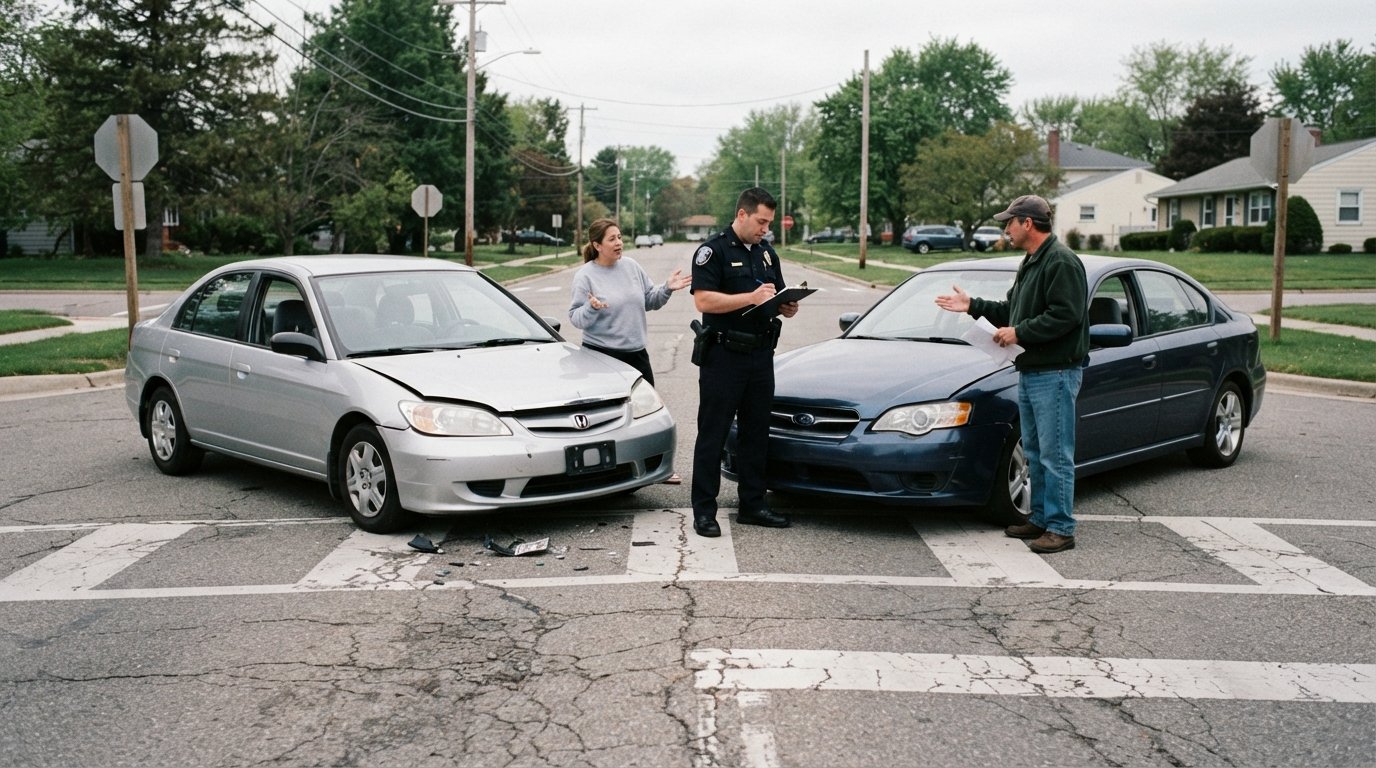
How Insurance Pays Out When Both Drivers Are at Fault
Shared-fault accidents reduce payouts by your percentage of blame. Call (833)-214-7506 to compare policies that protect you when fault is disputed.

You are sitting at a four-way stop when another car rolls through and clips your front bumper. The police report lists no clear violation. Your insurer says you share responsibility. The other driver's insurer says the same about their policyholder. Now you are staring at a repair estimate and wondering who actually pays for what. The answer depends on where the accident happened, how fault is allocated, and which coverage layers respond first. Understanding how insurance pays out when both drivers are at fault turns a confusing blame game into a predictable claims process.
Most drivers assume fault is binary: one person is responsible and everyone else gets paid. In reality, claims adjusters routinely assign percentages of fault to multiple parties. Your payout shrinks or grows based on those percentages, the negligence rules in your state, and the policy limits involved. This guide walks through the three main fault systems, shows how partial fault reduces your recovery, explains how to estimate your own layers of compensation, and covers the documentation that protects you when fault is disputed.
The Three Fault Systems That Decide Who Pays
Every U.S. state uses one of three frameworks to handle accidents where fault is shared: at-fault (tort), no-fault, or comparative negligence. The system determines whether you pursue the other driver's insurer, file with your own carrier, or both. It also controls whether your own negligence can bar you from recovering anything at all.
In a traditional at-fault state, the driver who caused the crash (or the larger share of it) is financially responsible. You file a claim with the at-fault driver's liability insurer, and that insurer pays for your property damage and injuries up to policy limits. If fault is split, insurers negotiate percentages and each carrier pays the portion its driver owes. Pure no-fault states take the opposite approach: after a crash, you file with your own personal injury protection (PIP) coverage regardless of who caused the accident, and lawsuits are restricted to serious injuries. Comparative negligence states sit in the middle, allowing recovery even when you share blame, but reducing your award by your percentage of fault.
The practical difference is enormous. In a no-fault state, your own policy pays your medical bills quickly, but you may not recover pain and suffering from the other driver unless your injuries cross a serious threshold. In a comparative negligence state, you can pursue the other driver, but your check is discounted by your share of responsibility. In a strict at-fault state with contributory negligence rules, even 1 percent fault could historically wipe out your claim, though most states have moved away from that harsh standard. Knowing which system applies to your accident is the first step toward predicting your payout.
How Partial Fault Reduces Payouts in Comparative Negligence States
Comparative negligence comes in two main flavors: pure and modified. Under pure comparative negligence, you can recover damages even if you are 99 percent at fault, but your award is reduced by your percentage. If a jury finds you 30 percent responsible for a $10,000 injury claim, you receive $7,000. Under modified comparative negligence, recovery is barred once your fault reaches a certain threshold, usually 50 or 51 percent. Cross that line and you receive nothing from the other party, no matter how sympathetic your circumstances.
The math works the same way for property damage. Suppose the repair bill for your vehicle is $6,000 and the adjuster assigns you 25 percent fault. The other driver's insurer owes 75 percent, or $4,500, subject to that driver's property damage liability limit. Your own collision coverage can handle the remaining $1,500, minus your deductible. If you carry collision, your insurer may also pursue subrogation against the other carrier to recover what it paid, which can eventually refund part of your deductible.
Fault percentages are not handed down from on high. Adjusters assign them based on police reports, witness statements, vehicle damage patterns, traffic camera footage, and state traffic laws. They negotiate with each other, and the final split often reflects leverage as much as truth. This is why documentation matters so much: a single witness statement or dashcam clip can shift a 50/50 split to 80/20 in your favor, changing your payout by thousands of dollars. If you disagree with the assigned percentage, you can challenge it with evidence, and in some states you can request an appraisal or invoke a formal dispute process.
Estimating Your Own Layers of Recovery Through Different Policies
When both drivers share fault, your compensation rarely comes from a single source. It flows through layers, and understanding the order helps you estimate what you will actually collect. The first layer is the other driver's liability coverage, which pays for your injuries and property damage up to their limits. The second layer is your own collision coverage, which repairs your vehicle regardless of fault, minus your deductible. The third layer is your medical payments or PIP coverage, which pays your medical bills without waiting for a fault determination. Additional layers include uninsured and underinsured motorist coverage, which steps in when the other driver has no insurance or insufficient limits.
Here is a simple framework for estimating your recovery in a shared-fault accident:
- Step 1: Establish the fault split. Gather the police report, witness contacts, and any dashcam or surveillance footage. Ask each insurer for its preliminary liability assessment in writing.
- Step 2: Calculate the gross damages. Add up vehicle repair estimates, medical bills, lost wages, and any other documented losses. Do not guess; use actual invoices and records.
- Step 3: Apply your fault percentage. Multiply the gross damages by the other driver's share of fault. That is the maximum the other insurer owes, subject to policy limits.
- Step 4: Check policy limits. Compare your calculated figure to the other driver's liability limits. If your damages exceed those limits, your underinsured motorist coverage may fill the gap.
- Step 5: Layer in your own coverage. Use collision for vehicle repairs and med pay or PIP for medical bills. Track your deductible, since subrogation may recover it later.
This framework works for most passenger vehicle claims, but specialized vehicles complicate the picture. Commercial trucks, motorcycles, RVs, and antique cars often carry different policy structures and limits, and fault disputes involving them can involve multiple insurers. If you are unsure how your policy responds, a licensed agent can walk you through the layers. You can also use tools like a total loss insurance payout calculator to estimate what a totaled vehicle settlement might look like before you negotiate.
One more layer deserves attention: your own liability coverage. If you are found partially at fault, the other driver can file a claim against your liability policy. That means your insurer may pay them, and your premiums could rise as a result. This is why carrying adequate liability limits matters even when you believe the other driver caused the crash. A shared-fault determination cuts both ways.
Documentation That Protects You When Fault Is Disputed
Fault disputes are won and lost on evidence. The driver who documents the scene thoroughly, promptly, and objectively has a significant advantage when adjusters negotiate percentages. Memory fades, witnesses move, and surveillance footage gets overwritten, so the hours and days after a crash matter enormously.
Start with the scene itself. Call the police and request a report, even for minor collisions. Exchange insurance and contact information with the other driver, but avoid apologizing or admitting fault; casual statements can be used against you later. Photograph all vehicles from multiple angles, capture the road layout, traffic signals, and skid marks, and collect contact information from every witness. If there is a dashcam in your vehicle, preserve the footage immediately and back it up to cloud storage. If nearby businesses might have security cameras, note their locations and ask the owners to preserve footage before it is overwritten.
After the scene, keep a detailed file. Save medical records, repair estimates, rental car receipts, and lost wage documentation. Request the police report as soon as it is available and review it for errors; a wrong diagram or misstated speed can skew the fault analysis. If you give a recorded statement to the other insurer, keep it factual and brief, and never speculate about speed, timing, or who did what. You are not obligated to provide a recorded statement to the other driver's carrier, and consulting an attorney before doing so is often wise in serious injury cases.
When fault is formally disputed, you have options. You can submit a written challenge to the adjuster with supporting evidence, request a supervisor review, or invoke your state's appraisal or arbitration process for property damage. For injury claims, a personal injury attorney can negotiate directly with the insurer and, if necessary, file suit before the statute of limitations expires. Deadlines vary by state, typically one to three years for injury claims and two to six years for property damage, so act promptly.
Finally, consider your long-term insurance strategy. Drivers in comparative negligence states often benefit from carrying collision, medical payments, and uninsured motorist coverage precisely because fault disputes are common. Comparing quotes from multiple carriers helps you find affordable limits that protect you in shared-fault scenarios. You can compare free auto insurance quotes online to see how different carriers price these layers, and a licensed agent can help you tailor coverage to your state's fault rules. NewAutoInsurance.com connects drivers with agents who can explain how your policy would respond in a disputed-fault accident, with no obligation to purchase.
Shared-fault accidents reward preparation. Know your state's negligence system, document everything, understand how each coverage layer responds, and challenge fault percentages when the evidence supports you. Whether you recover 50 percent or 90 percent of your damages often comes down to how well you built your case in the first 48 hours.