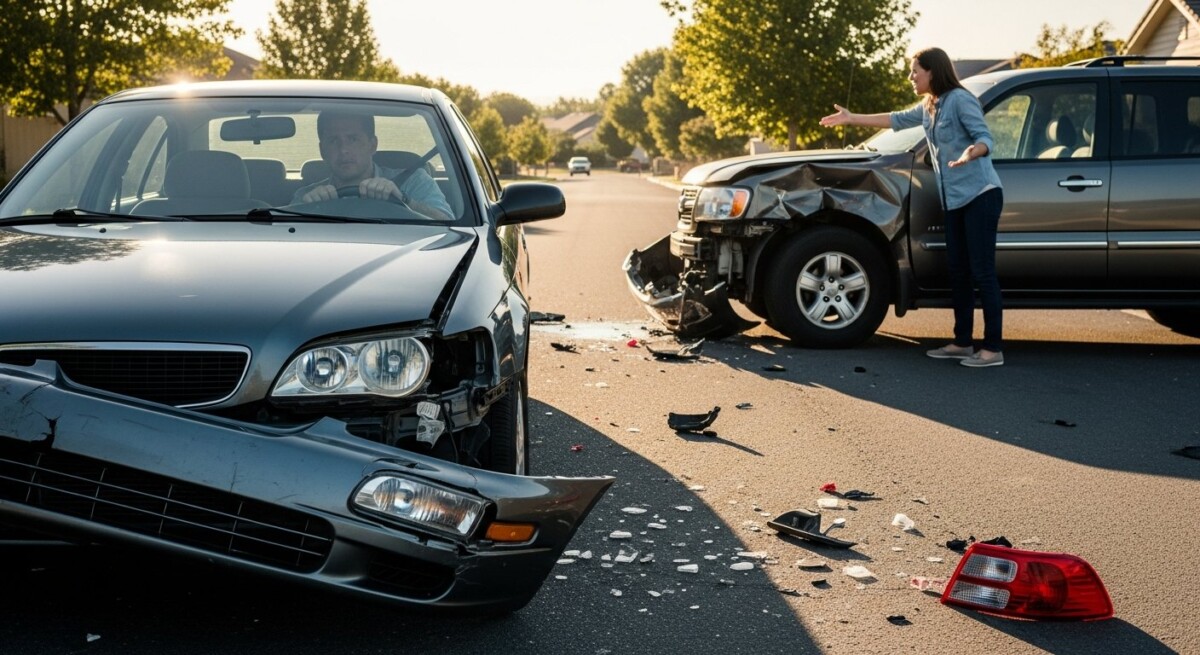
You are sitting in your car after a minor fender bender, exchanging information with the other driver. Your hands are steady, but your mind is racing. You carry the minimum liability insurance required by your state, and you suddenly wonder: if the other driver’s repairs or medical bills exceed your policy limits, will you be personally responsible for the difference? This moment of uncertainty is exactly why every driver needs to ask: is minimum liability insurance enough to protect your financial future? The short answer is usually no, but the full answer depends on your assets, your state, and your tolerance for risk.
What Minimum Liability Insurance Actually Covers
Minimum liability insurance is the lowest amount of coverage your state allows you to carry legally. It typically includes two main components: bodily injury liability per person and per accident, plus property damage liability. Bodily injury liability pays for medical expenses, lost wages, and legal fees for people you injure in an accident. Property damage liability covers repairs to the other driver’s vehicle or any property you damage, such as a fence or a mailbox.
Every state sets its own minimum limits, and they vary widely. For example, California requires 15/30/5, which means $15,000 per person for bodily injury, $30,000 per accident total for bodily injury, and $5,000 for property damage. Texas mandates 30/60/25, while Florida only requires $10,000 in personal injury protection and no bodily injury liability at all for most drivers. These numbers may sound reasonable on paper, but they are dangerously low when you consider the actual cost of a modern accident.
In our guide on Bodily Injury Liability Insurance: What It Covers, we explain how quickly medical bills can exceed $15,000. A single ambulance ride can cost $1,000 or more, and an emergency room visit for a broken arm can easily reach $5,000. If the injured party requires surgery or physical therapy, the total can skyrocket to $50,000 or higher. Your minimum policy would leave you personally on the hook for the difference, and that difference could wipe out your savings.
The Real Cost of an Accident: Why Minimum Limits Fall Short
Imagine you cause an accident that injures two people. Each person has $20,000 in medical bills. If your policy has a $30,000 per accident limit, you have only $30,000 total to split between them. That leaves $10,000 unpaid, and the injured parties can sue you personally to recover that amount. Even if you have no significant assets, a court can garnish your wages for years to satisfy the judgment.
Property damage limits are often even more inadequate. The average price of a new car in 2025 is around $48,000, and even a moderately priced sedan costs $30,000. If you rear-end a new SUV and cause $25,000 in damage, but your property damage limit is only $10,000, you owe $15,000 out of pocket. Add in a damaged guardrail, a streetlight, or a storefront, and the financial hole gets deeper.
Medical costs are not the only factor. Injured parties can also sue for pain and suffering, loss of consortium, and punitive damages. These non-economic damages are not capped by your liability limits, and juries often award substantial sums. Minimum coverage gives you no buffer against these claims. For a deeper look at how liability coverage works across different scenarios, read our Liability Insurance Auto: How to Stay Covered and Save Money article.
Who Might Be Okay with Minimum Coverage
There are a few narrow situations where minimum liability insurance might be acceptable. If you have no significant assets, no savings, and a low income, a plaintiff’s attorney may decide you are not worth suing. This is often called being judgment-proof. In that case, carrying minimum coverage keeps you legal and saves money on premiums. However, even judgment-proof drivers can face wage garnishment if a court orders it, and the judgment stays on your credit report for years.
Another scenario is if you only drive an old, low-value vehicle and rarely carry passengers. Your risk of causing high medical bills is lower if you drive alone, but it is not zero. A single accident involving a pedestrian or a cyclist can still produce massive liability. Finally, if you live in a state with very high minimum requirements such as Alaska’s 50/100/25, the gap between minimum and adequate coverage is smaller. Even then, $50,000 per person may not cover a serious injury.
The Case for Higher Limits: Umbrella and Stacking Options
Most financial experts recommend carrying at least 100/300/50 in liability coverage. That means $100,000 per person for bodily injury, $300,000 per accident, and $50,000 for property damage. For many drivers, the additional premium for this level of coverage is surprisingly affordable. Moving from state minimums to 100/300/50 often costs less than $20 to $40 per month, depending on your driving record and location.
For those with significant assets, a personal umbrella policy is even better. An umbrella policy provides an additional $1 million or more in liability coverage on top of your auto and homeowners policies. It activates when your underlying limits are exhausted, and it often covers legal defense costs as well. Umbrella policies are relatively inexpensive, typically costing $150 to $300 per year for $1 million in coverage.
If you are looking for a comprehensive overview of how liability coverage interacts with other protections, our Auto Liability Insurance: Essential Protection for Every Driver guide breaks down the different layers and how they work together to shield your finances.
Factors That Determine Your True Risk
Your personal risk profile is the most important factor in deciding whether minimum liability insurance is enough. Consider these key variables:
- Your net worth and liquid assets. If you own a home, have retirement accounts, or keep significant savings, you are a target for lawsuits. Higher limits protect those assets.
- Your daily driving environment. Commuting in a congested city with high traffic speeds increases your odds of a multi-car accident with severe injuries.
- Your state’s legal environment. Some states allow plaintiffs to collect pain and suffering damages easily, while others have tort reform that caps non-economic damages.
- Your driving history. Even one at-fault accident in the past five years suggests you are statistically more likely to have another.
- Whether you drive for work. Using your car for deliveries, rideshare services, or sales calls increases your exposure significantly.
After evaluating these factors, you may realize that the gap between your current coverage and adequate coverage is larger than you thought. The peace of mind that comes from knowing you are protected against a catastrophic loss is often worth the modest increase in premium.
State Minimums vs. Real-World Medical Costs
To illustrate the inadequacy of state minimums, consider the following comparison. In 2024, the average cost of a hospital stay for a trauma injury was over $60,000. The average cost of spinal surgery exceeded $100,000. Even a moderate injury requiring arthroscopic knee surgery can cost $15,000 to $30,000. Against these numbers, a $15,000 per person limit covers less than a single night in the ICU.
Property damage costs have also risen sharply. Modern vehicles contain expensive sensors, cameras, and structural components designed for crash safety. Replacing a single headlight assembly on a luxury car can cost $2,000 or more. A rear bumper with parking sensors can run $3,000. Total a $50,000 SUV with your $10,000 property damage limit, and you are personally responsible for $40,000.
For a detailed breakdown of how these costs have shifted over time and what coverage levels are recommended for different driver profiles, consult our Automobile Liability Insurance Guide. It provides state-by-state comparisons and practical advice for choosing limits that match your risk.
Frequently Asked Questions
Is minimum liability insurance enough if I have health insurance?
Your health insurance covers your own medical bills, but it does not cover the other party’s injuries. If you cause an accident, the other driver’s medical costs come out of your liability coverage. Your health insurance is irrelevant to that obligation. Minimum limits still leave you exposed if the other driver’s bills exceed your policy.
Will my rates increase if I raise my liability limits?
Yes, raising your limits will increase your premium, but the increase is usually modest. Going from state minimums to 100/300/50 typically adds 10 to 20 percent to your bill. Given the massive increase in protection, this is one of the best value upgrades you can make.
Can I be sued for more than my policy limits?
Yes. Your insurance company will pay up to your policy limits, but if the damages exceed those limits, the injured party can sue you personally. This is known as an excess judgment. If you have assets, they can be seized. If you have income, it can be garnished.
Does minimum liability insurance cover my own injuries?
No. Liability insurance only covers injuries and damages you cause to others. To cover your own medical expenses, you need personal injury protection, medical payments coverage, or health insurance. If you are at fault, your liability policy pays nothing toward your own care.
What happens if I cannot afford higher limits?
If your budget is extremely tight, carry the highest limits you can reasonably afford, even if that means cutting other expenses. The risk of a lawsuit is too high to ignore. Some insurers offer payment plans that spread the premium over monthly installments to make higher coverage more manageable.
Making the Right Choice for Your Financial Health
Minimum liability insurance is a legal floor, not a financial safety net. It keeps you on the road legally, but it does very little to protect your savings, your home, or your future earnings. The question is not whether you can afford higher limits. The real question is whether you can afford the financial devastation that follows an underinsured accident.
Review your current policy today. Compare your liability limits to your net worth, your daily driving habits, and the medical costs in your area. If you find a gap, request a quote for higher limits before your next renewal. The few extra dollars per month are a small price to pay for peace of mind and long-term financial protection.