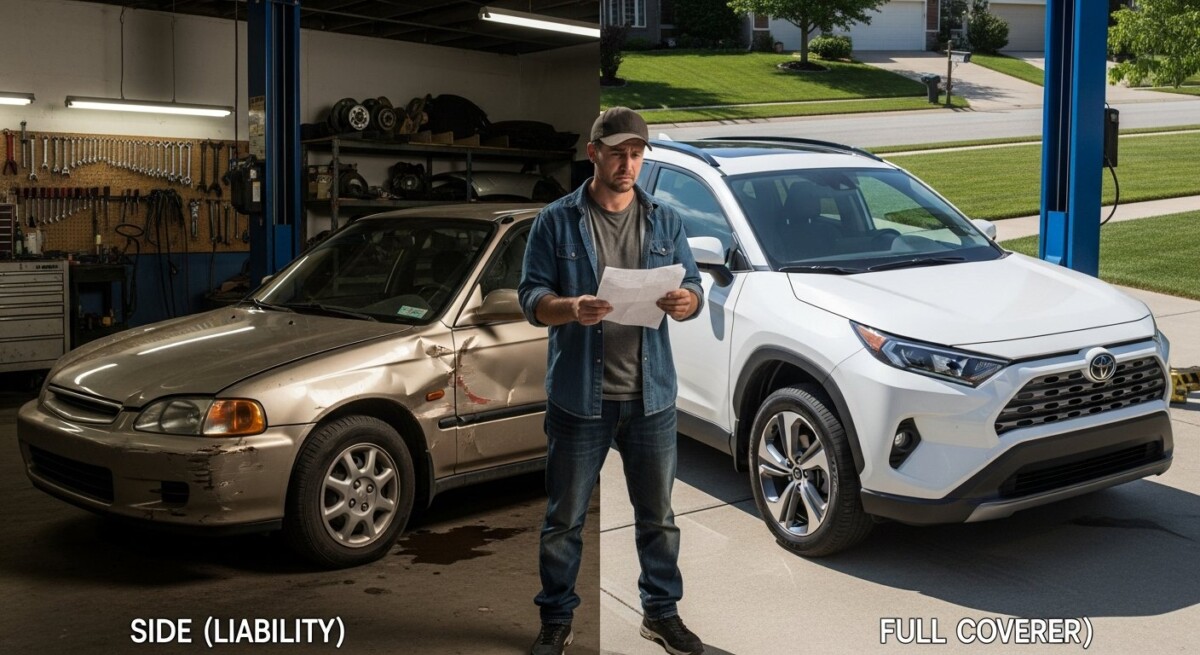
When you shop for auto insurance, the two most common terms you will hear are full coverage and liability. But what do these labels actually mean, and which one protects your wallet when the unexpected happens? Many drivers assume that full coverage is always better, while others choose liability solely because it costs less upfront. The reality is more nuanced. Your choice between full coverage car insurance vs liability depends on your vehicle’s value, your financial situation, and your tolerance for risk. This article breaks down each option, compares their costs and benefits, and helps you decide which policy fits your life.
What Is Liability Car Insurance?
Liability car insurance is the minimum coverage required by law in nearly every state. It pays for damages and injuries you cause to other people and their property in an accident where you are at fault. It does not cover your own medical bills or vehicle repairs. Liability insurance is split into two parts: bodily injury liability and property damage liability. Bodily injury liability covers the other driver’s medical expenses, lost wages, and legal fees if they sue you. Property damage liability pays for repairs to the other person’s vehicle or any property you damage, such as a fence or building.
State minimum liability limits vary widely. For example, California requires 15/30/5, meaning $15,000 per person for bodily injury, $30,000 per accident for bodily injury, and $5,000 for property damage. Other states like Alaska require 50/100/25. If you cause a serious accident and your liability limits are too low, you can be personally sued for the remaining costs. This is why many experts recommend carrying more than the state minimum, even if you choose liability-only coverage.
What Is Full Coverage Car Insurance?
Full coverage is not a single type of policy. It is a combination of liability insurance plus two additional coverages: collision and comprehensive. Collision coverage pays to repair or replace your own vehicle after an accident, regardless of who is at fault. Comprehensive coverage pays for damage from non-collision events such as theft, vandalism, hail, flood, fire, or hitting a deer. Together, these three coverages form what insurers and agents call full coverage.
Full coverage also often includes other optional protections like rental reimbursement, roadside assistance, and medical payments coverage. However, the core difference from liability is that full coverage protects your own vehicle and medical costs, not just the other party. Because of this broader protection, full coverage costs significantly more than liability alone. The trade-off is that you avoid large out-of-pocket expenses after a covered incident.
Full Coverage Car Insurance vs Liability: Cost Comparison
The price gap between liability and full coverage is substantial. According to national averages, a liability-only policy costs around $50 to $100 per month, while a full coverage policy runs between $120 and $250 per month. The exact difference depends on your driving record, location, age, credit score, and the vehicle you insure. For example, a 2023 Ford F-150 in Texas might cost $85 per month for liability and $190 per month for full coverage. A 2010 Honda Civic in Ohio might cost $45 per month for liability and $110 per month for full coverage.
Why the difference? Collision and comprehensive coverages are priced based on your car’s value and repair costs. A newer or more expensive vehicle will have higher premiums for these coverages. Liability only considers the risk you pose to others, not the value of your own car. If you have an older car worth less than $5,000, the cost of full coverage might exceed the potential payout from a claim. In that case, dropping collision and comprehensive could save you money without leaving you exposed to a major loss.
Deductibles and Their Impact on Cost
Full coverage policies include a deductible for collision and comprehensive claims. A deductible is the amount you pay out of pocket before insurance kicks in. Common deductible amounts are $500, $1,000, or $2,500. Choosing a higher deductible lowers your monthly premium but increases your financial responsibility if you file a claim. With liability insurance, there is no deductible because it only pays for damage you cause to others. You pay nothing out of pocket when you make a third-party claim, but you pay 100% of your own repair costs.
When comparing full coverage car insurance vs liability, consider how much cash you have available for an emergency. If you can comfortably afford a $1,000 deductible, you might save money by raising your deductible and keeping full coverage. If you have only a few hundred dollars in savings, a low-deductible full coverage policy or liability-only with higher limits might be safer.
When Liability Insurance Makes Sense
Liability insurance is the right choice for drivers who own older cars with low market value. A general rule of thumb is that if your vehicle is worth less than 10 times the annual premium for full coverage, you should consider dropping collision and comprehensive. For example, if full coverage costs $1,800 per year and your car is worth $8,000, you are paying more than 20% of the car’s value each year for coverage that only pays out the car’s actual cash value minus your deductible.
Other situations where liability may be sufficient include:
- You have an emergency fund large enough to replace your vehicle if it is totaled.
- You drive a second or third car that is rarely used.
- Your car is financed or leased and the lender requires full coverage (in this case, liability only is not an option).
- You are a very safe driver with no at-fault accidents in the past five years and want to minimize monthly costs.
Keep in mind that liability insurance does not cover theft, vandalism, weather damage, or animal collisions. If you park on the street in a high-theft area or live where hailstorms are common, the lack of comprehensive coverage could be a serious financial risk.
When Full Coverage Is Worth the Extra Cost
Full coverage is usually required by lenders if you have a car loan or lease. The lender wants to protect its investment, so they mandate collision and comprehensive until the loan is paid off. Even after the loan is paid, full coverage may still be wise if your car holds significant value. Luxury vehicles, new SUVs, and electric cars often cost tens of thousands of dollars to replace. Without full coverage, a single at-fault accident could leave you with a total loss and no payout.
Full coverage also provides peace of mind. If you rely on your car for work, school drop-offs, or medical appointments, the ability to get your car repaired quickly after an accident is valuable. Rental reimbursement coverage, which is often included in full coverage packages, can keep you mobile while your car is in the shop. In our guide on auto gap insurance, we explain how this extra layer can protect you if your car is totaled and you owe more than its depreciated value.
Additionally, full coverage protects you from non-collision events that liability ignores. A tree branch falling on your hood, a break-in that smashes your window, or a deer darting across the highway are all covered under comprehensive. Without it, you pay the full repair bill yourself.
How to Decide Between Full Coverage and Liability
Making the right choice requires a straightforward calculation. First, determine your car’s actual cash value using Kelley Blue Book or a similar valuation tool. Next, get quotes for both liability-only and full coverage from at least three insurers. Compare the annual difference in premium. If the difference is less than 10% of your car’s value, full coverage is likely worth it. If the difference is more than 20%, liability may be the smarter financial move.
Also consider your personal risk tolerance. Some drivers prefer to pay a higher premium to avoid surprise expenses. Others would rather save money each month and accept the risk of a large one-time cost. There is no universally correct answer. It depends on your budget, your car’s condition, and how much financial shock you can absorb.
For drivers who already have an accident on their record, the cost of full coverage can be especially high. In that case, you might explore accident forgiveness insurance as an add-on that prevents your first at-fault accident from raising your rates. This can make full coverage more affordable over time.
State Requirements and Legal Minimums
Every state except New Hampshire and Virginia requires some form of liability insurance. New Hampshire allows drivers to forgo insurance if they can prove financial responsibility, but this is rare. Virginia charges a $500 uninsured motorist fee to drive without coverage, but you still have no protection. All other states mandate minimum liability limits. Some states, like Florida and Michigan, also require personal injury protection (PIP) or medical payments coverage as part of the minimum policy.
Full coverage is never required by state law. It is a contractual requirement imposed by lenders or a personal decision. However, if you cause a serious accident with only state minimum liability, you could face wage garnishment, asset seizure, or bankruptcy. This is why even if you choose liability over full coverage, you should consider higher liability limits than the state minimum. A policy with 100/300/50 limits (meaning $100,000 per person, $300,000 per accident for bodily injury, and $50,000 for property damage) offers much stronger protection for a relatively small increase in premium.
Common Myths About Full Coverage and Liability
One frequent misconception is that full coverage means you are covered for everything. That is not true. Full coverage does not cover mechanical breakdowns, routine maintenance, or intentional damage. It also excludes certain high-risk activities like racing or using your car for rideshare services unless you have a specific endorsement. Another myth is that liability insurance covers your own medical bills. It does not. You need medical payments coverage or health insurance for that.
Some drivers believe that full coverage is a waste because they are good drivers. But even the safest driver can be hit by an uninsured or underinsured motorist. If the other driver has no insurance and you have only liability, your own repairs and medical bills are not covered. Adding uninsured motorist coverage (often included in full coverage policies) can close that gap. For more details on how different policies compare, see our analysis of assurance car insurance options.
Frequently Asked Questions
Can I switch from full coverage to liability at any time?
Yes, you can drop collision and comprehensive coverages at any point during your policy term. However, if your car is financed or leased, the lender will not allow you to remove those coverages until the loan is paid off. Check with your lender before making changes.
Does full coverage cover rental cars?
Full coverage typically extends to rental cars, but the level of protection depends on your policy. Your collision and comprehensive coverages usually apply to a rental vehicle you drive temporarily. However, rental reimbursement coverage, which pays for a rental while your car is being repaired, is a separate add-on.
What happens if I have liability only and cause an accident?
Your insurance pays for the other party’s damages up to your policy limits. You are personally responsible for any amount exceeding those limits, plus the full cost of repairing or replacing your own vehicle. You also pay your own medical bills unless you have health insurance or medical payments coverage.
Is full coverage worth it for an older car?
It depends on the car’s value. A rule of thumb is that if your car is worth less than $4,000 to $5,000, full coverage may not be cost-effective because the premium could exceed the potential payout. Calculate your car’s actual cash value and compare it to the annual cost of collision and comprehensive.
For drivers who want to compare local options, our resource on auto city insurance provides tips for finding affordable coverage in urban areas.
Choosing between full coverage car insurance vs liability is one of the most important financial decisions a driver makes. Liability saves you money each month but leaves you exposed if you cause an accident or your car is damaged by a non-collision event. Full coverage costs more but protects your own vehicle and provides broader peace of mind. Evaluate your car’s value, your savings, and your driving habits. Then choose the coverage that keeps you on the road without breaking the bank. Call our team at 833-214-7506 for personalized help comparing quotes in your state.