
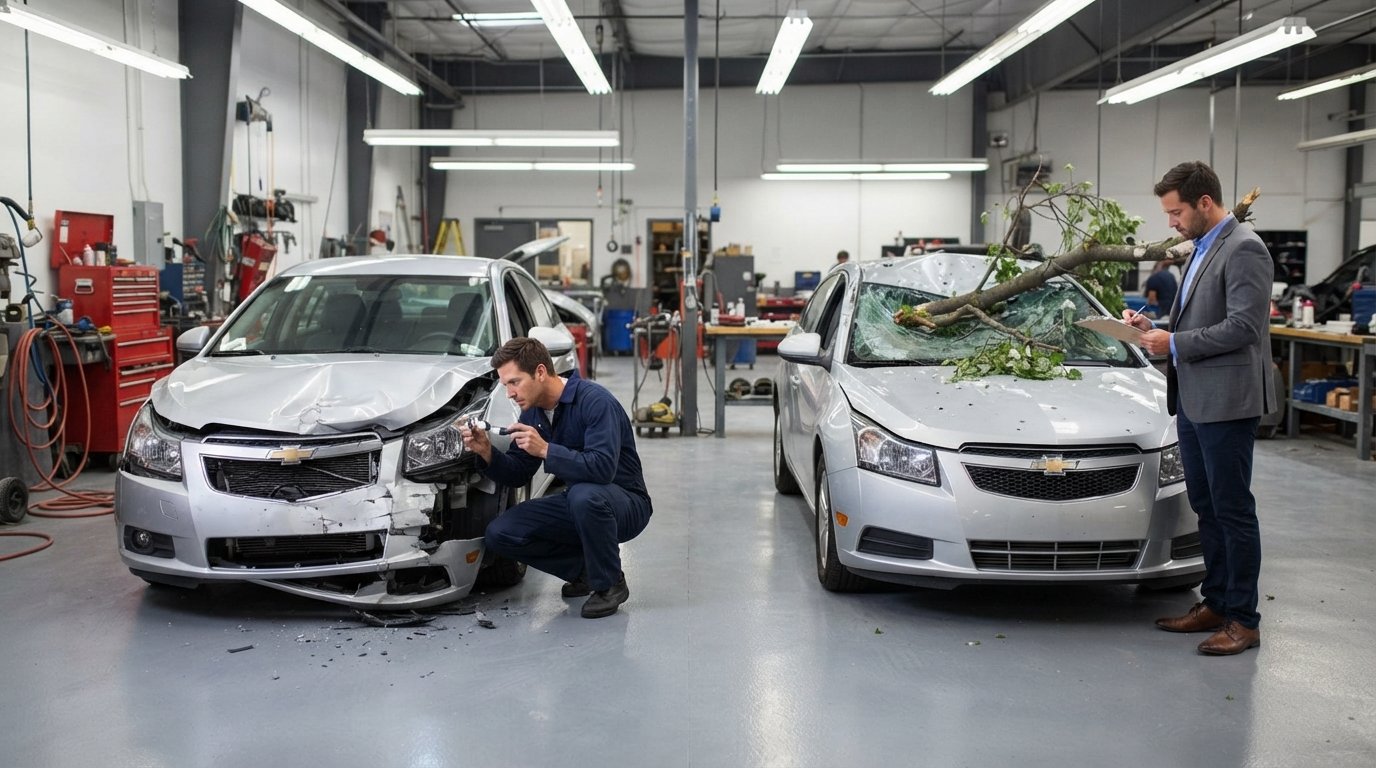
Comprehensive vs Collision Coverage Difference Explained
The comprehensive vs collision coverage difference decides which claim pays when your car is damaged. Learn which coverage handles theft, weather, and impacts.

By Julian Mercer
Your auto policy has two separate coverage types that handle vehicle damage, and mixing them up can cost you hundreds of dollars at claim time. One pays when a deer runs into your fender or a storm drops a branch on your hood. The other pays when you back into a mailbox or slide into a guardrail. Knowing the comprehensive vs collision coverage difference tells you which one responds to which event, why lenders often require one but not the other, and how your deductible shapes what you actually collect. This guide walks through both coverages side by side, using plain language and real scenarios, so you can choose limits and deductibles that match how and where you drive.
What Collision Coverage Actually Pays For
Collision coverage pays to repair or replace your own vehicle after it strikes another object or overturns, regardless of who caused the accident. The object can be another car, a telephone pole, a fence, a concrete barrier, or a parked shopping cart. If your car flips onto its roof during a swerve, that is a collision loss too. What matters is the physical impact between your vehicle and something else, or the rollover itself. The coverage does not depend on fault, so even if you caused the crash, your insurer still pays up to your policy limits, minus your deductible.
Because fault is irrelevant, collision coverage protects you from two painful outcomes at once. First, you avoid paying thousands out of pocket for bodywork, frame straightening, or a total loss settlement. Second, you do not have to chase the other driver's insurer for months while your car sits in the shop. Your own carrier handles the claim and may pursue the at-fault party later through subrogation, a process that rarely involves you beyond a few signatures.
Collision coverage is usually required when you lease a vehicle or take out an auto loan. The lender or leasing company wants assurance that its collateral will be repaired or paid off if you crash. Once the loan is satisfied, the requirement disappears, but many drivers keep the coverage anyway because replacing a car outright is far more expensive than paying a modest premium each month.
A few everyday examples show how broadly collision applies:
- Rear-ending another car in stop-and-go traffic on the interstate
- Sideswiping a guardrail while merging onto a highway
- Backing into a concrete pillar in a parking garage
- Hitting a pothole deep enough to bend a wheel and damage the suspension
- Rolling your vehicle after swerving to avoid debris on the road
Notice that none of these events involve weather, animals, or theft. That is the dividing line. Collision handles impacts and rollovers caused by driving, while a different coverage handles everything else that damages your car without an impact from another vehicle.
What Comprehensive Coverage Actually Pays For
Comprehensive coverage pays for damage to your vehicle from causes other than a collision with another object. The list of covered events is longer than most drivers expect. Theft, fire, vandalism, hail, floods, earthquakes, falling tree limbs, and animal strikes all fall under comprehensive. If someone keys your door in a parking lot or steals your catalytic converter overnight, comprehensive responds. If a windstorm sends a shingle through your rear window, comprehensive responds. If a deer jumps in front of your car on a rural road, that is also a comprehensive claim in most states, because the animal is not a vehicle and the event is not classified as a collision.
Comprehensive coverage also handles glass damage in many policies, often with a separate, lower deductible or no deductible at all. A cracked windshield from road debris, a shattered side window from a break-in, or a chipped mirror housing from a hailstorm can all be repaired under this coverage. Because these claims are frequent and usually inexpensive, insurers often process them quickly, and some carriers even waive the deductible for glass repair to encourage policyholders to fix chips before they spread.
Theft deserves special attention because it involves two separate payouts. Comprehensive covers the vehicle itself if it is stolen and not recovered, and it also covers damage that occurs during a theft attempt, such as a broken steering column or torn convertible top. If your car is recovered with a missing stereo or airbags, comprehensive pays to restore those items as well. This dual protection is why comprehensive is sometimes called other than collision coverage on policy documents, a phrasing that confuses many readers until they see the two coverages side by side.
Common comprehensive claims include:
- Hail dents across the hood, roof, and trunk lid
- Floodwater soaking the carpet, seats, and wiring harness
- A stolen vehicle or stolen parts such as wheels and catalytic converters
- Vandalism, including scratched paint, slashed tires, or broken mirrors
- Falling objects such as tree limbs, icicles, or debris from a storm
- Animal contact, including deer, raccoons, and birds
Like collision, comprehensive is usually optional unless your lender or lessor requires it. Also like collision, it carries a deductible that you choose when you buy the policy. The deductible applies per claim, not per year, so filing two comprehensive claims in one year means paying the deductible twice.
The Comprehensive vs Collision Coverage Difference in One Frame
The cleanest way to separate the two coverages is to ask a single question: did my car hit something, or did something hit my car? If your car hit another object, the claim falls under collision. If an external event, animal, person, or weather condition damaged your car without your vehicle striking anything, the claim falls under comprehensive. That one question resolves the comprehensive vs collision coverage difference in almost every real-world scenario you will face.
Another way to frame it is by fault and force. Collision coverage responds when the damage results from the operation of your vehicle, whether you were at fault or not. Comprehensive coverage responds when the damage results from an outside force that has nothing to do with how you were driving. This distinction matters because it affects deductibles, premium pricing, and how insurers calculate risk. Collision claims tend to cluster around dense traffic and inexperienced drivers, while comprehensive claims cluster around weather patterns, crime rates, and wildlife density in your zip code.
For a deeper walkthrough with state-specific examples and deductible math, see this guide to comprehensive vs collision coverage explained. It breaks down how each coverage interacts with liability, uninsured motorist protection, and total loss thresholds, which is useful once you move past the basic definitions.
Here is a quick comparison of how the two coverages differ on the details that affect your wallet:
- Trigger: Collision requires an impact or rollover; comprehensive requires a non-impact event such as theft, weather, or animal contact.
- Fault: Collision pays regardless of fault; comprehensive is never fault-based because no other driver is involved.
- Deductible: Both carry a deductible you choose, but comprehensive deductibles are often set lower because claims tend to be smaller.
- Requirement: Lenders and lessors typically require both coverages; once the vehicle is paid off, both become optional in most states.
- Premium impact: Collision usually costs more because repair bills are higher and claims are more frequent in urban areas.
Understanding these five dimensions helps you decide whether to carry one, both, or neither. Dropping collision on an older car can save money, but dropping comprehensive on a vehicle parked outside during hail season can be a costly gamble.
Deductibles, Premiums, and the Math Behind Your Choice
Both coverages use a deductible, which is the amount you pay before the insurer covers the rest of the repair or replacement cost. If your collision deductible is 500 dollars and the body shop bills 3,200 dollars, you pay 500 and your insurer pays 2,700. If the same car is stolen and recovered with 1,800 dollars in damage, your comprehensive deductible applies to that claim separately. Raising either deductible lowers your premium, while lowering it raises your premium, often by 10 to 20 percent per 500 dollars of deductible change.
The break-even calculation is simpler than it looks. Suppose lowering your comprehensive deductible from 1,000 to 250 dollars adds 60 dollars per year to your premium. You would need to file a comprehensive claim roughly every 12 years for the lower deductible to pay off, assuming average claim sizes. If you live in a hail-prone state or park on a street with frequent break-ins, that math shifts in favor of the lower deductible. If your car is garaged, driven rarely, and worth modest amounts, the higher deductible usually wins.
Vehicle value also drives the decision. Once a car is worth less than a few thousand dollars, the maximum payout from either coverage is capped at the actual cash value, which is the replacement cost minus depreciation. Paying 400 dollars a year for collision and comprehensive on a car worth 2,500 dollars means you are spending 16 percent of the vehicle's value annually for protection that may never exceed a few thousand dollars. At that point, many drivers drop both coverages, self-insure the difference, and redirect the savings toward a newer vehicle or an emergency fund. To compare real quotes from multiple carriers before you decide, you can request free auto insurance quotes online and see how each deductible and coverage combination changes your monthly bill.
When You Are Required to Carry Each Coverage
State law rarely mandates collision or comprehensive coverage. What states require is liability insurance, which pays for damage you cause to others. Collision and comprehensive protect your own vehicle, so the decision is usually yours, with one major exception: lenders and leasing companies. If you finance a car, the lender will require both coverages until the loan is repaid. If you lease, the leasing company will require them for the entire lease term, often with specific maximum deductibles written into the contract.
Lenders enforce these requirements through force-placed insurance, a costly policy the lender buys on your behalf if you let coverage lapse. Force-placed policies protect only the lender's interest, not yours, and they are far more expensive than anything you would buy yourself. If you drop coverage without notifying your lender, you may find a charge on your next loan statement that is difficult to remove.
Even when coverage is optional, carrying both is often wise for newer vehicles. A single hail storm or theft can wipe out years of premium savings in one afternoon. The rule of thumb many consumer guides use is to keep both coverages while your vehicle is worth more than 10 times the annual premium for the two coverages combined. Below that threshold, the cost of protection starts to outpace the benefit.
How the Two Coverages Work Together in a Claim
In practice, you rarely need to decide which coverage applies before calling your insurer. You describe what happened, and the claims adjuster classifies the loss as either collision or comprehensive based on the facts. A tree limb falls on your car: comprehensive. You swerve to avoid the limb and hit a mailbox: collision. A shopping cart rolls into your door: comprehensive in most policies, because no collision with a vehicle occurred. You hit a shopping cart in the lot: collision, because your car struck an object.
If you carry both coverages, the adjuster simply applies the correct one and your deductible follows. If you carry only one, and the loss falls under the other, you receive nothing for your own vehicle damage. That is the practical risk of dropping one coverage to save money: you may save 200 dollars a year and lose 6,000 dollars in a single uncovered event.
Multiple-vehicle households can also mix coverages across cars. It is perfectly legal to carry collision and comprehensive on a new SUV and liability-only coverage on an older commuter car. Insurers price each vehicle separately, so this strategy lets you protect the asset that would be expensive to replace while saving on the car you could afford to write off. Review your coverage mix whenever your household adds or removes a vehicle, because bundling decisions and multi-car discounts can shift the math.
Frequently Confused Scenarios, Resolved
Some claims sit close to the line between the two coverages, and knowing which way they fall prevents surprises. Hitting a deer is comprehensive in nearly every state because the animal is not a vehicle and the event is treated as an animal strike. Hitting a cow, however, can be classified differently depending on state rules and whether the animal was in the road. Hitting a pothole is generally collision, because your tire and wheel struck the road surface, though some insurers treat it as a comprehensive loss when no other object is involved. Vandalism is always comprehensive, even if the vandal used a tool that dented the car.
Weather-related losses are comprehensive across the board. Hail, flood, wind, lightning, and falling ice all fall under comprehensive, regardless of whether you were driving at the time. If you drive into a flooded intersection and the engine hydrolocks, the claim is usually comprehensive because the damage came from water, not from striking another object. If you skid on ice and hit a curb, that is collision, because the impact with the curb caused the damage.
Theft-related claims follow comprehensive even when the thief damages the car while stealing it. A broken window, a torn ignition column, and a ripped-out stereo are all comprehensive losses. If the thief crashes your car during the theft, that portion of the damage may be classified as collision, but the theft itself remains comprehensive. Insurers handle these mixed claims by separating the losses and applying the appropriate deductible to each, which is one reason thorough police reports matter after a theft.
When in doubt, report the claim and let the adjuster classify it. Misclassifying a claim on your own can lead you to expect the wrong deductible or the wrong payout. The comprehensive vs collision coverage difference matters most at the moment you file, so describe the event precisely: what hit what, and in what order.
Choosing between comprehensive and collision coverage comes down to what you drive, where you park it, and how much risk you can absorb without financial strain. Both coverages protect your own vehicle, but they respond to different events, carry separate deductibles, and make sense for different vehicle values. Review your policy at every renewal, confirm which coverages your lender requires, and adjust deductibles as your car ages. A few minutes spent comparing the two can save you thousands when the unexpected happens.